
Written by Michiel R. De Boer
I want to describe an organisation. You may recognise it.
It has good people. Capable, educated, experienced people who care about the work and want the organisation to succeed. Its strategy is coherent, not perfect, but coherent. It has governance structures, performance management systems, and a leadership team that meets regularly and takes its responsibilities seriously.
Every two years or so, there is a reset. Sometimes it is a strategy refresh. Sometimes it is a restructuring. Sometimes it is a new leadership initiative: a culture programme, a digital transformation, a new operating model. Sometimes it is all three, sequentially, within the same period.
The reset is always justified. The problems being addressed are always real. The intervention being proposed is always rational given the problems. And then, a year or two into the new direction, the organisation finds itself in a familiar place: the same underlying frictions, the same handoff failures, the same disengagement patterns, the same gap between the intention and the reality, wearing the new initiative’s vocabulary but occupying the same structural position that the previous initiative was supposed to displace.
Leadership is not incompetent. Effort is not lacking. Investment is not small. The organisation is not a failure.
It is an organisation that has never stopped to examine its own workings as a connected whole. It is solving problems it has not yet learned to see.
What All Eleven Stories Have In Common
This is the series’ culminating piece, and it earns its position only if it does what the ten pieces before it have been building toward: to show that the eleven stories are not eleven separate problems, but eleven expressions of the same underlying pattern.
The finance manager who withdrew her discretionary effort after her trust was broken. The new hire who arrived exceptional and became ordinary inside an environment that had no design for sustaining his motivation. The high-performer whose quiet erosion went unnoticed because the metrics were calibrated to minimum expectations, not individual potential.
The well-intentioned manager who developed her team’s technical capability at the cost of their independence. The star performer who failed in the leadership role that seemed like his natural next step. The team that never decided because its governance of harmony had crowded out its governance of accountability. The crisis-brilliant team that fell apart in ordinary conditions because the crisis was the culture.
The strategy that nobody implemented because the governance structure was calibrated to quarterly delivery rather than strategic change. The innovation that died in the approval process because the organisation’s immune system could not distinguish between risk and novelty. The reorganisation that reproduced the silos it was designed to dissolve because the structural solution was applied to a cultural problem.
These are not unrelated incidents. They are all manifestations of the same underlying pattern: an organisation that responds to the visible symptom with a targeted intervention, and does not examine the system that produced the symptom.
The trust contract breaks, and the organisation responds with an engagement programme. The high-performer disengages, and the organisation responds with a retention package. The new hire underperforms, and the organisation responds with more rigorous selection. The leader inhibits initiative, and the organisation responds with a leadership training course. The team cannot decide, and the organisation responds with a decision-making workshop. The strategy is not implemented, and the organisation responds with a change management initiative. The innovation dies in approval, and the organisation creates an innovation lab. The silos re-form after the restructure, and the organisation plans another restructure.
Each response is reasonable. None of them address the system that keeps producing the same problems.
The System That Produces The Pattern
There is a system underneath all eleven stories. It is not a broken system. It is a partially assembled one.
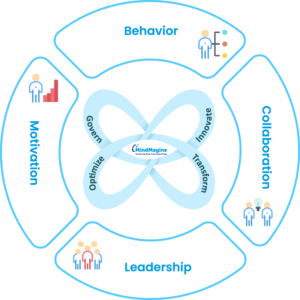
Every organisation has some version of governance: the structures, processes, and accountability mechanisms that manage risk, ensure compliance, and maintain strategic direction. Every organisation has some version of innovation: the activities, forums, or pockets of creative thinking that generate new approaches to old problems. Every organisation has some form of transformation: the change initiatives that attempt to move the organisation from its current state to a better one. And every organisation has some version of optimisation: the continuous improvement, efficiency work, and performance management that keeps operations running and improves them over time.
The GITO® Approach does not invent any of these elements. It names what is already there, and asks the question that most organisations never ask: are these elements connected?
In most organisations, they are not. Governance operates as a separate function from innovation. Transformation is a project with a start and an end date, not a continuous orientation. Optimisation is owned by operations and disconnected from strategy. The elements exist, but they are siloed, and the silos between the organisational improvement functions are, in a kind of systemic irony, often as pronounced as the silos between the operational functions those improvement efforts are trying to fix.
The result is improvement that does not compound. Each initiative produces results within its own domain. But because the domains are not connected, the insights from one do not inform the others. The learning from a failed change initiative does not improve the governance structure. The efficiency gains from optimisation are not systematically redirected into innovation investment. The cultural shifts that transformation work is designed to produce are not sustained by leadership behaviour or governance structure, because neither was involved in the transformation’s design.
The organisation improves in episodes rather than continuously. It learns locally rather than systemically. It solves problems rather than building the capability to prevent them.
And so, every two years or so, the same problems return. In new costumes, with new vocabulary, in a different organisational shape, but recognisably the same problems. The same trust erosion. The same motivation failure. The same execution gap. The same structural response to a cultural problem.

The Four Human Enablers: The Thread That Runs Through Everything
Every story in this series has a human layer beneath the organisational layer. This is not incidental. It is the point.
The trust contract (Piece 1) is, at its root, a Motivation failure: the organisation has built conditions that erode intrinsic investment rather than sustaining it.
The new hire who underperforms (Piece 2) is a Motivation failure and a Leadership failure: the conditions for purpose, autonomy, and mastery were not created, and the manager responsible for creating them was not equipped to do so.
The high-performer who stops performing (Piece 3) is a Leadership failure: the management discipline of staying curious about the people who appear to need no attention was absent.
The leader who kills initiative (Piece 4) is a Leadership and Behaviour Management failure: the leader’s feedback habits produced the wrong behavioural norms at scale without anyone designing them.
The star performer who fails in leadership (Piece 5) is a Leadership and Behaviour Management failure: the organisation deployed talent without equipping it.
The team that cannot decide (Piece 6) is a Collaboration failure: the conditions for productive conflict were never built.
The team that burns out (Piece 7) is a Motivation failure: the intrinsic foundations were replaced by extrinsic urgency, and when the urgency lifted, the motivation was gone.
The strategy nobody implemented (Piece 8) is a Leadership and Behaviour Management failure: the governance was calibrated to protect the old behaviours, not build the new ones.
The innovation that died in approval (Piece 9) is a Collaboration and Governance failure: the structures were not designed to enable the cross-boundary, risk-tolerant work that innovation requires.
The reorganisation that created new silos (Piece 10) is a Behaviour Management and Collaboration failure: the structure was changed and the culture was not.
The four enablers (Behaviour Management, Collaboration, Leadership, Motivation) are not add-ons to the GITO® lifecycle. They are its operating system. Without them, every element of the loop is technically present and functionally compromised. With them, the elements reinforce each other. Governance that is behaviourally reinforced is actually followed. Innovation that happens in a culture of psychological safety produces better ideas, more quickly. Transformation that is led by leaders who model the new behaviours actually changes daily reality. Optimisation that is driven by a motivated, collaborative workforce produces improvements that hold.
The four enablers are what makes the loop self-sustaining rather than self-defeating.
What The GITO® Approach Actually Requires
I want to be direct about this, because the risk of any framework is that it becomes a description of outcomes rather than a guide to the work that produces them.
The GITO® Approach requires the discipline to see the system before treating the symptom. That discipline is not natural. It runs against the grain of organisational life, which is oriented toward visible problems, immediate causes, and fast interventions. The patience to ask “what produced this problem, and is our proposed solution going to become part of the problem?” is genuinely difficult to maintain under operational pressure. It requires a quality of leadership thinking: slow, systemic, honest about the organisation’s role in creating its own difficulties. Most organisations do not reward it in the short term.
It requires the willingness to take the four human enablers seriously as a first priority, not as a supplementary consideration. The instinct, when facing an organisational problem, is to reach for structural, process, or technology solutions, because these are tangible, auditable, and produce visible outputs. Behaviour change is slow. Culture change is slow. Leadership development is slow. Building intrinsic motivation takes months and years, not weeks. These timelines are uncomfortable for organisations that measure progress in quarters.
But the organisations that have done this work, that have invested seriously in the human foundations before building further, compound their improvement with every cycle. The governance they build is actually followed, because the behaviour change was done first. The innovation they generate is actually implemented, because the psychological safety was built first. The transformation they undertake actually holds, because the leadership behaviour and the motivational foundations are aligned with the direction rather than working against it.
The organisations that skip the human layer produce improvement that does not hold and change that does not stick. And they reset every two years.
The Choice
This series began with a CEO in Kuala Lumpur who asked, genuinely baffled: “We keep doing the right things. Why are we still in the same place?”
The answer, as I hope these eleven pieces have made clear, is that the right things, done in isolation, without a systemic view of what produces the problems they address, accumulate into the architecture of the very difficulties they were designed to solve. Not because the people doing them are wrong. Because the habit of treating problems as separate has prevented the organisation from seeing them as connected.
The choice is not between improvement and stagnation. It is between improvement that compounds and improvement that resets. Between building an organisation that becomes progressively more capable with each cycle, and an organisation that solves the same problems with slightly different names at regular intervals.
The GITO® Approach does not make this choice for you. No approach does. What it provides is a way of seeing: one that lets an organisation examine its own patterns, identify what is producing the symptoms it keeps treating, and invest in the foundations that make every other improvement self-sustaining.
The question I want to leave you with is not whether your organisation faces the patterns described in this series. If you have read this far, you know it does, in some combination, to some degree. The question is what you are prepared to do about it, and specifically, whether you are prepared to do the kind of systemic work that produces lasting results, rather than the kind of episodic work that produces temporary relief.
The answer to that question is the difference between the organisation that keeps solving the same problem every two years, and the organisation that eventually stops needing to.
A Note On Where To Begin
If this series has produced a kind of diagnosis without a clear starting point, let me offer one.
Begin with the human layer. Not because the other elements are less important. They are not, but because the human layer is the foundation that everything else stands on. Governance structures are only as strong as the behaviours that sustain them. Innovation processes are only as productive as the psychological safety that makes honest ideas possible. Transformation initiatives are only as durable as the leadership behaviour and motivational conditions that carry them past the initial energy.
Ask, within your own organisation: where is the trust contract most fragile? Where are the high performers whose quiet erosion has gone unnoticed? Where is the leadership behaviour producing dependency rather than capability? Where is the harmony in a team protecting the group from a difficult conversation it needs to have? Where is the strategy failing to become behaviour?
These are not abstract questions. They have specific, nameable answers in every organisation. Finding them requires the willingness to look at what the standard metrics are not designed to show, at the invisible patterns beneath the visible performance. That looking is the beginning of the systemic work.
And it is the only beginning that does not, two years from now, bring you back to the same place.
This is the final piece of a twelve-part series exploring the patterns behind organisational dysfunction, and what the GITO® Approach reveals about addressing them at the system level.
The series was written by Michiel de Boer for MindMagine’s GITO® Practice. For organisations ready to examine what system they have built: and what they want to build instead: MindMagine partners with leadership teams across APAC and globally to co-create GITO® implementations grounded in the four human enablers.
The question worth sitting with is not whether your organisation recognises itself in these pages. The question is how long you are prepared to leave it unaddressed.
