
Written by Michiel R. De Boer
Six months after the board approved it, the AI strategy document was still the most viewed file in the organisation’s shared drive. The head of strategy had circulated it to every department head. The CEO had referenced it in the town hall. The document was clear, well-designed, and grounded in market research. It articulated a compelling vision for becoming an AI-enabled organisation within three years.
When I spoke to the team responsible for implementation, three things had happened since approval. One pilot had been extended. One vendor had been evaluated. And a working group had been formed to identify further use cases.
The strategy was excellent. The operating model did not exist.
What the difference actually is
An AI strategy answers the question of what the organisation intends to become. It articulates the ambition, productivity gains, competitive advantage, new capability, cost reduction, and provides the rationale for why now and why this approach.
An AI operating model answers the question of how the organisation will actually get there. It specifies who owns AI decisions and at what level, how use cases are identified and prioritised, what governance applies to different categories of AI deployment, how performance is measured, and what happens when something fails or underperforms.
Most organisations have invested significantly in the first. Almost none have the second.
This is not a criticism of the strategy documents. It is an observation about an organisational capability gap that the documents themselves cannot close. A strategy that cannot be executed is not a strategy; it is a statement of aspiration. The operating model is what converts aspiration into movement.
The failure rate the market has confirmed
Forrester Research puts the failure rate for independent AI adoption attempts, organisations deploying AI without external strategic and implementation support, at 75%. Three in four. This is not a technology failure rate. The technology, in most of these cases, was adequate for the task. It is an operating model failure rate.
The pattern is consistent enough to be described structurally. The organisation approves a strategy. A small team is assigned to implementation alongside their existing responsibilities. They select a use case, often one that was already being discussed before the strategy was approved. A vendor is engaged. A pilot runs. The pilot produces results that are presented to leadership. Leadership responds positively. The pilot continues. Nothing scales.
Meanwhile, the strategy document is updated to reflect the pilot. The next board presentation notes progress. The organisation has technically fulfilled its commitment to AI adoption while substantively doing what it would have done without the strategy: one small experiment, bounded, and not connected to the way the organisation actually works.
Forrester’s number captures the organisations that eventually recognise this pattern and acknowledge the gap between what was intended and what was built. The majority reach that recognition after 18 to 24 months and a significant budget allocation.

What an operating model actually contains
An AI operating model is not a lengthy document. The organisations making the most consistent progress with AI adoption tend to have operating models that are brief, clear, and actively used rather than filed.
The core elements are five.
Ownership and accountability. Who has authority over AI decisions? Not nominal sponsorship, actual decision rights. Which decisions can be made at team level, which require a domain owner, which require executive approval? In most organisations, this is genuinely unclear, which means that every decision escalates or stalls.
Use case prioritisation. How are AI initiatives selected? What criteria distinguish a high-value use case from a distraction? Who evaluates the criteria? Without a clear prioritisation framework, organisations default to the use cases that are easiest to build or most championed by the loudest voice, neither of which reliably produces value.
Governance by tier. Different categories of AI deployment carry different risks and require different governance. An AI tool that summarises internal meeting notes requires different oversight than an AI system that makes customer-facing decisions. The operating model specifies what governance applies to what tier, and who is accountable for ensuring it.
Performance measurement. Before a use case is approved for deployment, the operating model specifies how its performance will be measured against business outcomes. Not usage statistics, not number of prompts, not time saved in isolation, business outcomes. Revenue, cost, quality, speed, risk reduction. The measurement architecture is established before deployment, not reconstructed afterwards.
Failure and feedback loops. What happens when an AI initiative underperforms? Who makes the decision to modify, pause, or stop it? In most organisations, the absence of a formal review process means that failing initiatives continue because no one has the mandate to call them.
The organisations making real progress typically have a small number of clearly mandated owners, a simple decision framework that is actually applied, and a measurement structure that connects AI activity to business outcomes. They are the minority.
The APAC operating model challenge
In APAC organisational contexts, the operating model challenge has a specific cultural dimension that generic AI strategy frameworks do not address.
In hierarchical organisations, which describes most GLCs, financial institutions, and large multinationals operating in the region, the absence of a formal operating model is not experienced as a vacuum. It is experienced as an implicit instruction to wait for direction. Middle managers who might otherwise make AI adoption decisions within their domains are waiting for clear authorisation from above. Senior leaders who could provide that authorisation are waiting for the strategy to be fully articulated before committing.
The result is a peculiar stasis: a strategy that everyone has endorsed and no one is implementing, in which the absence of movement is not resistance but a rational response to unclear mandate.
The operating model is the instrument that breaks this stasis, because it names who has what authority to do what. In high power-distance cultures, explicit authorisation is not bureaucratic overhead, it is the permission structure that allows the organisation to move.
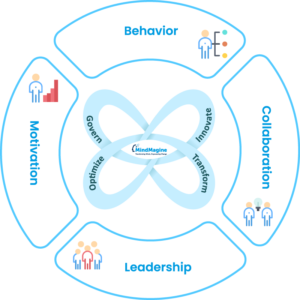
The GITO® Govern framework addresses this directly. Governance is not about restriction; it is about clarity of mandate. An organisation whose AI governance is clear about who can decide what, and at what level, is an organisation that can move.
The most common mistake: governance after deployment
The operating model failure is compounded by a sequencing error that is almost universal in AI adoption. Governance structures are designed after deployment rather than before it.
A team builds a pilot. The pilot works. Leadership approves expansion. Someone asks about the data governance implications. Someone else asks about the accountability structure if the model behaves unexpectedly. Someone asks how performance will be measured. These questions, which should have been answered before the pilot was designed, are now being answered under time pressure with a deployed system that people have already integrated into their workflows.
The GITO Approach addresses this directly in the Innovate domain: use case design includes governance design. The governance questions are not an afterthought to the technical build; they are prerequisites for it. Organisations that establish this sequencing once, even imperfectly, produce AI initiatives that are more likely to scale because the infrastructure for scaling was considered from the beginning.
What to do: building the operating model
Start with ownership, not policy. The first document an AI operating model requires is a one-page ownership map: which executive owns AI strategy, which operational owners have authority over AI decisions within their domains, and what decisions require cross-functional sign-off. This takes one senior meeting to produce and removes the ambiguity that is stalling most AI programmes.
Establish a prioritisation framework before the next use case. Before the organisation’s next AI initiative is approved, define the criteria against which it will be evaluated: what business problem does it address, what is the baseline performance of the current approach, what would success look like in measurable terms, and who is accountable for delivering it. This framework, applied consistently, is worth more than any individual use case it evaluates.
Define governance tiers before they are needed. Map the organisation’s likely AI use cases against a three-tier classification: low-risk deployments that can proceed at team level with standard controls; medium-risk deployments that require domain-level review; high-risk deployments that require executive sign-off and ongoing oversight. Establish the criteria for each tier before a specific use case forces the classification question.
Connect measurement to business outcomes from day one. For every AI initiative already in flight, ask: what business outcome was this designed to improve, and how are we measuring whether it has? For initiatives that cannot answer this question, establish the measurement framework immediately, even if the baseline data requires effort to construct. Measurement architecture retrofitted six months after deployment is better than no measurement architecture, but the baseline is gone.
Review quarterly, not annually. The AI operating model is a living document. The landscape, tools, capabilities, risks, regulatory requirements, changes too fast for annual review cycles. A standing quarterly review, attended by the AI operating model owners, keeps the model current and creates a visible governance cadence that signals the organisation’s seriousness to everyone watching.
The honest assessment
The question is not whether your organisation has an AI strategy. It almost certainly does. The question is whether the strategy has an operating model beneath it — the decision rights, the prioritisation framework, the governance tiers, the measurement architecture, and the feedback loops — that convert intention into movement.
If the answer is no, the strategy is a document. That is not a failure; it is the starting condition for almost every organisation in APAC right now. The operating model is what you build next.
