
Written by Michiel R. De Boer
There is a moment that repeats itself in board rooms across Asia Pacific and everywhere else right now.
Someone asks: “So where are we with AI?”
A slide appears. It shows fourteen pilots, a Copilot rollout, three vendor demos and a policy document. Everyone nods. Then the CFO asks a simple question. Which one of these changed a number in our accounts?
The room goes quiet.
This is not a failure of ambition. The ambition is there. It is not a failure of technology either. The models work. It is something less dramatic and much harder to fix. The organisation bought a capability before it built the operating infrastructure that capability needs.
This article is about what is actually going wrong, based on what the current research shows and what shows up again and again in real programmes. It is written for the people who have to answer for it: senior management, decision makers, HR and L&D.
First, let us read the numbers honestly
You have probably seen the headline that 95 percent of AI pilots fail. It is worth being careful with that one, because a senior audience will ask you where it came from.
It comes from a July 2025 report by MIT Media Lab’s Project NANDA, called The GenAI Divide: State of AI in Business 2025. It was widely reported as proof that almost all enterprise AI fails. Critics have since pointed out that it was a preliminary working paper, that success was defined narrowly as measurable profit and loss impact within roughly six months, and that the 5 percent figure came from a funnel for one category of custom embedded tools. The same report showed general purpose tools such as ChatGPT and Copilot performing much better. I have not independently verified the underlying data, so please treat the number as a signal rather than a law of nature.
The less dramatic numbers are more useful anyway.
McKinsey’s State of AI global survey, published in November 2025 and based on roughly 1,500 organisations, found that approximately 88 percent of respondents report regular AI use in at least one business function, up from about 78 percent the year before. Yet nearly two thirds say their organisation has not begun scaling AI across the enterprise, and only about 39 percent report any EBIT impact at enterprise level. Around 6 percent qualify as high performers, meaning they attribute 5 percent or more of EBIT to AI.
Put plainly: almost everyone is using it. Very few are getting paid for it.
That gap is not a technology gap. It is where the real work sits. Below are the four places it usually hides.

Struggle one: your people are already using AI and you cannot see it
Ask most executives what AI tools their people use, and you get the sanctioned list. The reality is wider.
The 2026 PagerDuty Shadow AI Survey, conducted by Wakefield Research among 1,250 office professionals in non-IT roles at companies with revenue above 500 million dollars across Australia, Japan, the UK and the US in April 2026, found that approximately 66 percent had used AI tools at work even though they believed this was not permitted under company policy. Around 39 percent said they would rather use AI without telling anyone than risk being told no, rising to roughly 47 percent in businesses above one billion dollars in revenue. About 86 percent believed their organisation had an AI policy. More than 80 percent believed leadership operates under a different set of rules.
A separate March 2026 study by Okta and Apprize360, covering 292 executives and 492 knowledge workers across seven countries, found approximately 52 percent of knowledge workers admitted using unapproved AI tools, with the highest rates in the US and the lowest in France and Germany.
Both are vendor commissioned surveys, so treat the exact percentages as directional rather than precise. The direction is consistent across many studies, and it points somewhere uncomfortable.
Shadow AI is not an obedience problem. It is a demand signal.
People are not going around the policy because they are careless. They are going around it because the approved route is slower than the unapproved one. When the sanctioned path takes six weeks of procurement and the unsanctioned path takes ninety seconds and a personal account, the outcome is decided before anyone reads the policy.
For HR this matters more than it looks. The obvious risk is data leaving the organisation. The quieter risk is invisibility. Capability is growing in the dark. It is uneven, unrecorded, and attached to individuals rather than to the organisation. When those individuals leave, the capability leaves with them, and nobody can even describe what was lost.
Better questions than “how do we stop this”:
- What are people actually using, and for which tasks?
- What would make the approved route the fastest route?
- Which two tools can we properly assess and approve this quarter?
- Who are our internal power users, and why are we treating them as a risk instead of an asset?
Struggle two: pilots that never leave the pilot
The strange thing about stalled AI programmes is that most of the pilots worked. They did what they were asked to do. They just never became how the work is done.
There are usually three reasons, and they are almost never technical.
Nobody redesigned the work. The tool was placed on top of a process that was designed for humans doing every step. The same handoffs, the same approvals, the same three meetings. The result is small time savings scattered thinly across many people, which is real but invisible in any financial statement. McKinsey’s research consistently finds that workflow redesign is the practice most associated with organisations seeing genuine bottom line impact. Redesign is the differentiator. The tool is not.
Nobody owned it after the demo. The pilot lived with the innovation team or with IT. The business unit that would actually have to change how it works was a guest, not a sponsor. When the pilot ended, ownership had nowhere to go.
There was no route to production. No security review, no data decision, no budget line, no support model, no training plan. The pilot ends, and the question of who pays for scale has no answer, so nobody asks it out loud.
Practical fix, and it costs nothing. Before the next pilot begins, write one page that answers five questions:
- Which specific process are we changing?
- Which steps disappear entirely?
- Who owns the redesigned process after go live?
- What happens to the time that is saved?
- What will we be able to see in ninety days?
Question four is the one most teams skip, and it is the one that decides everything. If the honest answer is “we do not know”, the pilot has no destination. Time saved with no plan for what to do with it simply evaporates back into the working day.
Struggle three: the board asks about ROI and gets usage statistics
Weekly active users. Number of prompts. Licences deployed. Percentage of staff trained.
These are all real numbers. None of them is a return.
Measurement without a model produces numbers, not insight. A simple model has four levels, and value only becomes credible when you can show a line between them.
- Are people using it? Weak evidence, but you need it.
- Can people do things they could not do before, or do them to a higher standard? Take a sample of real work, before and after.
- Has something moved in a defined process: cycle time, error rate, cost per case, throughput, rework?
- Revenue, cost, risk, service level.
The common mistake is jumping from level one to level four in a single board slide. Nobody believes it, and they are right not to.
The credible path is narrower and much stronger. Prove level three in one process. Show the arithmetic that connects it to level four. Then repeat.
One more honest point. A six month profit and loss test is a hard bar for any change programme, and much AI value does not arrive in that shape. It arrives as avoided cost, faster onboarding, fewer escalations, less dependence on scarce specialists, better quality of decisions. That value is real, but it only counts if you agreed to count it before you started. Decide what you are measuring before you build, not after the board asks.
Struggle four: agents in production, decision rights undefined
This is the newest problem and the one moving fastest.
In June 2025 Gartner predicted that more than 40 percent of agentic AI projects would be cancelled by the end of 2027, citing escalating costs, unclear business value and inadequate risk controls. Note what is not on that list: model quality. Gartner also warned about agent washing, meaning products relabelled as agents without meaningful agentic capability. More recent Gartner material in 2026 suggests only around 17 percent of organisations have actually deployed agents, while well over half expect to within two years. That gap between intention and readiness is exactly where cancellations come from.
McKinsey’s AI trust survey published in early 2026, covering roughly 500 organisations, found nearly two thirds naming security and risk as the top barrier to scaling agents, ahead of regulatory uncertainty and technical limitations. The constraint is confidence, not capability.
Here is the useful way to think about it. An agent is not a tool. It is closer to a colleague without a contract. Tools do what they are told. Agents make choices inside a boundary, and if nobody has drawn the boundary, the agent draws its own.
Guidelines are not enough. Decision rights are. Before any agent runs in production, six questions should have clear answers:
- What decisions can it make alone, and what must it escalate?
- What is the financial and reputational limit of any single action it takes?
- Who is accountable when it gets something wrong, by name and role?
- What is logged, who reviews the log, and how often?
- How does a human stop it, and how quickly?
- How do we know it still performs the way it did on day one?
If those cannot be answered in a normal meeting, the agent is not governed. And this is not an IT decision. It is a governance decision that happens to involve software.

The part HR and L&D own, and almost everyone gets wrong
Here is the finding that should worry L&D leaders most.
Docebo’s AI Readiness Gap report, published in early 2026 and based on research by Centiment among 2,000 respondents across six countries, split evenly between employees and learning leaders, found that approximately 85 percent of employees say the training they receive does not help them use AI in their role. Nearly 60 percent said learning programmes are not designed with people like them in mind. Around one in five had received no AI training at all.
The TalentLMS 2026 L&D report points the same way. Roughly 73 percent of employees said they would use AI more effectively if training were specific to their job role, while only about 38 percent said their current AI training actually is role specific.
Again, these are vendor published studies, so read them as direction rather than precision. But the direction is unmistakable.
The conclusion is not that training does not work. It is that generic training does not work. “Introduction to AI” produces awareness in everyone and capability in nobody. A supply chain planner and a marketing writer face completely different AI tasks. Training them identically is efficient for L&D and useless for both of them.
What tends to work better, offered here as a recommendation rather than a proven result:
Teach the task, not the technology. Start from a real deliverable the person produces every week. The report, the proposal, the case summary, the roster. Build the training around improving that specific thing.
Teach in the flow of work. Short, contextual, close to the moment of use. Most skill building already happens on the job. Work with that rather than against it.
Measure capability, not completion. A course completion rate tells you about attendance. Set a behavioural target instead. For example: within thirty days, a defined percentage of participants use a specific tool for a specific task at least twice a week. Then report that to leadership as a capability number.
Recruit your shadow AI users. They are your early adopters. They already know which tools work for which tasks. Bringing them into the design of the programme is faster and cheaper than any external curriculum, and it converts hidden capability into shared capability.
Be honest about jobs. If people suspect the AI programme is a quiet route to headcount reduction, adoption slows down and honest feedback stops entirely. Say what you know. Say clearly what you do not know yet. People can handle uncertainty. They handle dishonesty much worse.
Do not forget the middle. Middle managers are being asked to hold the delivery target and lead the change at the same time, usually with no help and no reduction in their day job. They are the single biggest point of failure in most transformation programmes, and the least supported.
What the ones that work do differently
Across the research and across real programmes, the pattern is consistent and unglamorous.
- They pick one workflow that genuinely matters, instead of ten that are convenient.
- They redesign the work before they choose the tool.
- They name a business owner accountable for the outcome, not for the pilot.
- They agree the measure before the build.
- They make the approved route the fastest route, so shadow use stops being rational.
- They govern autonomy with decision rights, not with guidelines.
- They treat capability as infrastructure: continuous, role specific and measured.
Notice that none of this is about which model you chose.
A simple structure for the conversation
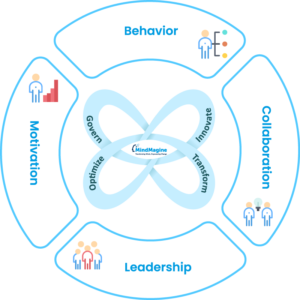
If you want a way to organise this in your leadership team, four questions cover most of it. We use them as Govern, Innovate, Transform and Optimise.
Govern. Who decides, who is accountable, what is allowed, and how do we know what is actually happening?
Innovate. Where could this create real advantage, and where are we just adding noise?
Transform. What has to change in how work is organised, and who is leading that change?
Optimise. What do we measure, how do we improve it, and how do we make it stick?
Most stalled programmes are strong on Innovate and weak on the other three. That is the whole story in one sentence.
The honest conversation
You do not need a strategy offsite to start. You need ten minutes in your next leadership meeting and four questions:
- What AI tools are our people actually using today, and how do we know that?
- Which single process have we genuinely redesigned, rather than just supported with a tool?
- If the board asks for the return next month, what number do we show and where does it come from?
- For every agent running in production, who is accountable when it is wrong?
If those questions are uncomfortable, that is useful information. Discomfort in a meeting room is a great deal cheaper than discomfort in an audit.
The technology is ready. In most organisations, the operating infrastructure around it is not. That is a solvable problem, but only for the leaders willing to have a genuinely honest conversation about where they actually are.
If you want a structured way to run that conversation, the GITO AI Assessment walks through it with you. Read the articles, engage with Aileen about your specific challenge or simply have a chat with us.
