
Written by Michiel R. De Boer
Something triggered me this week about a conversation I had in Kuala Lumpur a few years ago. The CEO of a mid-sized manufacturer sat across from me, genuinely baffled. His company had the right strategy. He had good people: experienced, educated, motivated in the way that people are motivated when they first join a company they believe in.
They had invested in systems. They had governance. They had, in the previous eighteen months alone, run three separate improvement initiatives, each of which had been signed off at the board level, each of which had produced results on paper, and none of which had changed how the organisation actually felt to work in.
“I don’t understand it,” he said. “We keep doing the right things. Why are we still in the same place?“
I have heard some version of that question more times than I can count. Always from leaders who are sharp, who care, who are doing exactly what good management literature tells them to do. And I have come to believe that the question itself contains the answer, or at least, contains the place you need to look.
The problem is not that they keep doing the wrong things. The problem is that they keep doing the right things in isolation, one after another, and accumulating the side-effects of each intervention into the architecture they live inside.
This series is about that pattern. About what it looks like, why it persists, and what it takes to actually break it.
The Anatomy Of A Stuck Organisation
Here is what getting stuck usually looks like from the inside.
The strategy is clear, or clear enough. Everyone can articulate the direction. But when you walk across departments, you find each team has translated that direction into something slightly different. Marketing hears “grow faster.” Finance hears “spend less.” Operations hears “run tighter.” Product hears “ship more.”
Each translation is internally consistent. None of them are the same thing. And nobody is lying. They are each genuinely doing what the strategy means to them.
So the organisation runs hard in four slightly different directions simultaneously, and the friction at the handoff points is brutal.
Meanwhile, there is governance.
Processes, policies, sign-off requirements, review boards. Some of it is excellent. A lot of it accumulated during a crisis: a compliance failure, a quality problem, a regulatory audit, and was never revisited once the crisis passed. The process that was designed to stop one specific bad thing from happening is now stopping seventeen other things from happening too, and nobody remembers quite why it exists anymore, so nobody feels authorised to question it.
And then there is the talent. Capable people who came in energised and are now, a few years in, quietly going through the motions. Not disengaged in a dramatic way. Just… smaller than they used to be. Doing the job, hitting the numbers, not offering much more than what was asked. The manager they liked left. The project they believed in got cancelled. The feedback they needed never came. Nobody noticed the erosion as it happened. It was gradual, invisible, and by the time it shows up in an engagement survey, the cost has been accumulating for months.
The organisation is not broken. It is exhausted. And the instinct, when an organisation recognises itself in this description, is usually to reach for another intervention.
That instinct is understandable. And it is usually what makes the situation worse.

The Accumulation Problem
McKinsey’s large-scale transformation research is clear on the failure rate: somewhere between 70 and 80 percent of transformation programmes do not deliver their intended results. Prosci’s annual benchmarking studies, drawn from thousands of change initiatives globally, identify the same root cause year after year: people and culture. Not technology. Not strategy. Not process design. The human dimension, whether people actually change how they behave, whether leadership models what it asks of others, whether motivation is built or only borrowed, determines most of whether a transformation holds.
And yet the majority of interventions are designed around everything except that.
When strategy feels unclear, the response is more strategy work. Workshops, documents, roadshows. This is rational. Direction returns. Then things drift, and a governance layer is added. Policies, review boards, sign-off requirements. Drift slows. Then teams fall behind, and each department builds its own solution: a new reporting tool, a new planning cycle, a new coordination meeting. The gap closes.
Each of these interventions was the right call at the time. None of them were wrong. But over years, the sum of those rational decisions becomes the architecture of the difficulty. The governance layer that stopped the drift also added friction to every decision. The coordination meetings that aligned the departments now consume the hours that used to go to the work itself. The reporting tools that made performance visible now require more time to feed than the insights they produce are worth.
This is not a failure of intelligence or intention. It is a systemic pattern that emerges from the perfectly reasonable habit of treating each problem as a separate problem, and solving it with a separate solution.
What is required is not another solution. It is the discipline to see the system, to understand what has been built, what it is doing, and what needs to shift at the level of the whole before anything else is added to it.
What the GITO® Approach actually is
GITO® stands for Govern, Innovate, Transform, Optimise. But I want to be direct about what that means and what it does not mean, because the names can mislead you.
It is not a framework you apply to an organisation. It is not a methodology you run as a project. It is not a consulting programme with a defined start and end date. The distinction matters because the instinct, when you see a four-part model, is to ask which phase you are in, when you will be done, and what comes next. That instinct is the accumulation problem in miniature. It is the habit of treating the whole as a sequence of separate interventions.
The GITO® Approach is a way of seeing organisational reality that was already there, waiting to be named. Every functioning organisation is already doing some version of governing, innovating, transforming, and optimising, but usually not as a connected system, usually not simultaneously, and usually not with the human foundations that make each element self-sustaining.
Governance without transformation produces compliance theatre: rules that are followed in audits and ignored in practice. Innovation without governance produces excitement without direction: ideas that never survive contact with the organisation’s operating reality. Transformation without optimisation produces change that costs more than it returns. Optimisation without innovation produces efficiency in a direction that may no longer be right.
The infinity loop design is not decorative. It reflects the fundamental principle: insights from each element strengthen the others. Governance informed by the reality of how people actually work becomes less bureaucratic and more effective. Innovation embedded in a culture of psychological safety produces ideas that come from the people closest to the problem, not only from the people with the most seniority. Transformation sustained by intrinsic motivation holds after the external pressure has passed. Optimisation that frees capacity for innovation creates momentum rather than merely reducing cost.
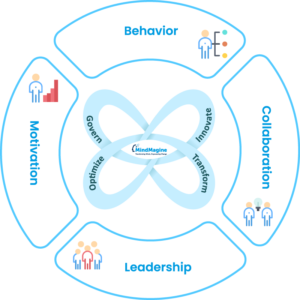
Beneath all four elements sit four human enablers. They are what make the loop work in practice, not in theory.
Behaviour Management is the discipline of building new habits rather than announcing new policies. The neuroscience is clear: established behaviours are encoded as near-automatic routines that fire with very little conscious effort. New behaviours require sustained effort to become reliable. Most implementation plans treat behaviour change as an afterthought. In practice, it is the first thing.
Collaboration is the structural and relational condition that determines whether strategy survives the handoff between teams. Not collaboration as a value statement, but collaboration as a designed operating reality: one that accounts for the specific cultural dynamics of the organisation, especially in high-context, high power-distance environments where direct challenge of authority is not a realistic norm.
Leadership is the translation mechanism between organisational intent and daily reality. Not leadership as a title or a set of competencies assessed annually. Leadership as daily behaviour: the way a manager runs a meeting, responds to a mistake, gives feedback, or fails to give it. The research on this is consistent: what a leader does is exponentially more powerful than what a leader says.
Motivation is the difference between compliance and commitment. Deci and Ryan’s Self-Determination Theory, developed across four decades of research, identifies three core drivers of sustained intrinsic motivation: purpose, autonomy, and mastery. Organisations that build these conditions do not need to worry about engagement surveys. Organisations that rely on extrinsic pressure alone will find that pressure needs to be continuously renewed: and that it loses effectiveness over time.
These four enablers are interconnected in a way that makes each one stronger when the others are present. Strong behaviour management makes collaboration more honest. Strong collaboration amplifies leadership effectiveness. Strong leadership builds intrinsic motivation. And motivated people sustain the behaviours that governance requires. Miss one, and the whole system carries the gap.
What This Series Is
Over the next eleven pieces, I am going to walk you through eleven stories. Each one describes a pattern. The organisations are different. The sectors, the sizes, the contexts vary. But the underlying dynamic repeats with striking consistency.
The stories move from the individual to the whole. We begin with the most human level: the trust between a person and the organisation they work inside. We move through leadership behaviour, team dynamics, organisational design, and finally to the systemic: the organisation that has been solving the same problem for a decade and cannot yet see why.
Each story stands on its own. You do not need to have read the previous one to understand the next. But if you follow the arc, something accumulates, not a model, not a framework, not a methodology, but a way of seeing. By the end, I hope you will have the instinct to ask, before reaching for the next intervention: what system have we built, and is this intervention going to help us, or is it going to become part of what we carry?
Each piece follows a consistent structure. A scene from organisational life. The pattern beneath it. The research that explains why it is so persistent. What it actually costs, not in the obvious ways, but in the ways organisations do not usually measure. And then what to do about it: specific, implementable, calibrated to the realities of an organisation that has real politics, real hierarchy, real constraints.
I am not interested in advice that sounds right in a seminar and falls apart on Monday morning. I have been in enough organisations to know that the distance between a good idea and a lasting change is where most of the interesting work lives.
The Question Worth Sitting With
Before the next piece, I want to leave you with one question. Not several: just one.
Think about the last significant improvement initiative your organisation ran. Not whether it succeeded on its own terms, but whether the problem it was designed to solve has stayed solved.
If the answer is yes, you are in an unusual position and I would genuinely like to know what you did.
If the answer is no, or more honestly, if the answer is “we haven’t checked”; then you are in the place where this series begins.
The pattern is not a judgment. It is not evidence of poor leadership or bad strategy or inadequate investment. It is evidence of something more fundamental: an organisation that has been solving problems without yet learning to see the system those problems live inside.
That is what we are here to change.
This is the introduction to a twelve-part series on the GITO® Approach by MindMagine. The series draws on two decades of implementation experience across Asia-Pacific and globally, grounded in research from organisational psychology, change management, and leadership science.
The next piece: The trust contract: the most relatable and immediate place to begin, and the foundation that everything else stands on.
